Podcast Episode: America’s National Parks Podcast
Where can you explore a volcanic wilderness while watching brown bears gorge on salmon during an annual fat-bear championship? In Alaska, of course. There’s a national park in the far north that’s only accessible by boat or plane, and it promises an unforgettably wild adventure.
On this episode of the America’s National Parks Podcast: exploring the wild volcanic wonders of Katmai National Park and Preserve.
A Place for the Wild
If you’re looking for a wildlife adventure in a unique geological park with an explosive history, Katmai is the place for you.
Katmai National Park and Preserve is nestled along the Alaska Peninsula, north of Kodiak Island and southwest of Anchorage, stretching from the famous Bristol Bay lowlands to the Pacific Ocean.
Alaska is a big place. The state is larger than California, Texas and Montana combined. Katmai itself is 4.3 million acres – nearly the size of Connecticut – and its boundaries help protect wild species in the region. Stellar sea lions, seals, otters, and orcas swim off the coast. 500 miles of marine coastline make Katmai one of the top seashores of any national park, and offer some of the best walrus-viewing in all of Alaska.
Katmai is a haven for majestic creatures like wolves, moose, and caribou, along with red fox, beaver, wolverine, lynx and birds of prey. Millions of salmon spawn in Katmai, and you’ll find rainbow trout, pike and dolly varden in the lakes and rivers. Of the 30,000 brown bears in Alaska, several thousand make their home in Katmai.
A Volcanic Past
Amidst this incredible biodiversity of wild plants and animals, Katmai National Park and Preserve is also home to one of the world’s most active volcanic areas. There are more than a dozen volcanoes in the park, seven of which have been active in the last century.
And for three days in June of 1912, the largest volcanic eruption of the twentieth century exploded from a new volcano called Novarupta.
There were warning signs the week of the Novarupta eruption. Just days before the eruption, severe earthquakes were felt as far as 160 miles to the north.
Novarupta’s eruption brought 60 hours of darkness. The land was covered in a foot of ash, collapsing roofs and structures. Water became undrinkable. 40 square miles of once-lush landscape was buried beneath volcanic deposits hundreds of feet deep.
Within a day, the ash spread 625 miles east. The cloud moved over North America and even reached all the way to Algeria. Weeks later, smoke and haze were observed from British Columbia to Europe. By blocking out the sun, the effects of the eruption lowered temperatures by two degrees in the northern hemisphere for more than a year.
So much magma escaped beneath Mount Katmai that part of its summit collapsed. This created the Katmai caldera and the area botanist Robert Griggs named the Valley of Ten Thousand Smokes. Glaciers and fields of ice carved deep lakes.
But it wasn’t until 1968, through the work of Garniss Curtis, that we understood the vent of the eruption was Novarupta, not Mount Katmai as previously thought. Though Mount Katmai collapsed during the eruption, most of the magma was actually vented at Novarupta, six miles away.
Novarupta has become one of the most intensely studied eruptions in the world.
For the first time in recorded history, an eruption deposited flows on land rather than sea. Katmai was declared a national monument in 1918 to preserve the park as a living volcano laboratory. The deposits left behind continue to provide insights about volcanic behavior.
In fact, research on the Novarupta eruption shaped current thinking about volcanic processes. Early U.S. geological surveys and National Geographic Society investigations have provided great insight into the unusual geology left in the wake of this historic eruption. By 1980, the boundaries of the national monument were extended to protect wilderness and wildlife, and Katmai National Park and Preserve was born.
The People of Katmai
Even in Katmai, such a great area of wilderness, far from urban centers, it would be wrong to think of it as a pristine land untrammeled by man. It is a vibrant ecosystem, with species and peoples that have existed together for tens of thousands of years.
Native Alaskan peoples go back to the last ice age. Indigenous cultures include the Inuits, Yupiks, and Aleuts.
Underground homes protected some from cold winters, while other people came to visit for salmon runs in the summer, staying in temporary shelters. Before the 1912 eruption, there were year-round villages and seasonally used camps in what is now Katmai National Park and Preserve.
As they do now, the streams teemed with salmon, near tundra plains were crossed by migrating caribou, along with rivers, lakes, and vast coastal shores frequented by marine animals.
A trail over Katmai pass allowed people to access an abundance of food and share stories and cultures. The national historic landmarks and prehistoric sites in the park are outstanding sources of cultural value and archaeological insight.
Descendants of the first inhabitants of this land continue traditions of subsistence hunting and fishing and keep kinship with the land alive and strong. According to the National Park Service, people with historic ties to Katmai are largely of Alutiiq/Sugpiak [Soog-pyack] descent. Many participate in the park management processes.
Like other national parks across North America, the management of these lands for all those who share it, works best in synchronicity with local and native peoples.
Bear Watching at Brooks Falls
But of course, there’s more than human communities here in Katmai.
Every summer, there’s an eruption in the park that isn’t coming from the volcanoes. In late June, sockeye salmon burst into park waters from the northern Pacific ocean. Driven by instinct, the salmon return to the gravel beds of headwaters to spawn.
Not far from Katmai, the renowned natural beauty of Bristol Bay is the world’s greatest sockeye salmon run. It is a lifeblood for Alaska native cultures. Salmon are a vital source of food for Katmai people, eagles, and of course, bears.
Bears have been threatened for the last decade from a proposed open-pit copper mine. Thankfully, the Clean Water Act protects this great area. And that makes neighboring Katmai all the more important for this ecosystem, especially for brown bears.
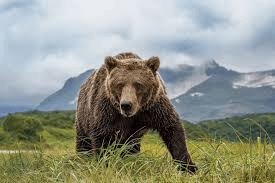
And Katmai has bears plenty. While Black bears in North America are common, brown bears are less so. Both species come in a variety of colors: Black bears can be brown and Brown bears can be red, for example. But they are different species.
A brown bear (called Ursus arctos) is often larger than a black bear (Ursus americanus), eats differently, behaves differently, and fights differently too.
Brown bears and grizzly bears, on the other hand, are the same species. Where grizzlies live inland, brown bears are coastal and often even larger than grizzly bears.
They often share a distinctive shoulder hump with a lower rump, teddy-bear like round ears, with a dished-in facial profile between their eyes and the tip of their snout.
And along with Katmai’s volcanic legacy and geologic features, brown bears are a large part of the powerful attraction of Katmai National Park and Preserve. People come from around the world to watch brown bears fish for salmon during their migration to Katmai.
When it comes to the best bear watching, visitors should plan on checking out Brooks Camps in July or September.
At peak season, Brooks Camp is an all-you-can-eat buffet for brown bears. And these bears can eat.
In fact, a brown bear in Katmai has only six months to eat a year’s worth of food to survive.
So the bears at Brooks Camp get busy doing just that.
Brown bears fish for salmon along the Brooks River. There are also three wildlife viewing platforms along the river: at the waterfalls, downstream, and at the mouth of the river. Each offers a unique experience depending on the time of the season.
In fact, salmon is so plentiful in early summer at Brooks Falls that things get a little wild.
As bears fatten up for the winter, a behavior known as hyperphagia, they accumulate fat reserves. Adults can gain up to 500lbs or more and can even consume as much as 120lbs of salmon a day (about 30 fish). Weight gain also helps mama bears have successful pregnancies to get through hibernation and nurture cubs through the winter.
The biggest male bears, also called boars, tend to dominate the competitive scene at the falls. Female bears, also called sows, tend to move with their cubs near the mouth of the Brooks River, where it’s a bit safer for them.
In July, many of the bears gather at Brooks Falls, just over a mile from the visitor center. The bears leave Brooks Camp in August in search of better meals as food dwindles. But they’re back again in September, this time at the mouth of the river, for a final chance to fatten up before the cooler weather comes.
In September, as the salmon begin to spawn and die, bears move to the lower half of the river. At this point in the season the bears are looking for salmon that collect in the slow moving currents near the river mouth.
Fat Bear Week
By October, the bears in Katmai should be nearing peak fatness.
For those who wish to get a taste of the bear-watching experience before they visit, the National Park Service offers a “bear-cam” for viewers around the world. This allows viewers to watch live action at Brooks falls, day or night, and even view highlight reels.
Every year, the park service and Explore.org host Fat Bear Week. Viewers vote for the fattest bear to move through the brackets of a single-elimination tournament.
And at first, yes a contest about beefy bears in a volcanic park on the coast of Alaska might seem a bit whimsical. Indeed, it started as a bit of fun.
But there’s actually more to it than meets the eye.
Former park ranger Mike Fitz founded the competition first as Fat Bear Tuesday in 2014. Fitz noticed the online interest in livestreams of the brown bears feeding on salmon at the falls. A contest was organized where viewers review before-and-after photos of bears fattening up for the winter, and then vote on their favorite champion.
For the last decade, the contest evolved to Fat Bear Week. A few years ago, they even added a junior bracket for the up and coming yearlings and bear cubs. Not surprisingly, watching chubby young bears feed at the river draws a big viewership.
But here’s the serious part. Katmai National Park sponsors the competition to raise awareness about the values of conservation.
Each year, the bears are profiled, followed, studied, and celebrated by viewers. The contest also generates interest in and support for conservation of a remote wilderness that not everyone can visit. Donations include charities like the Katmai Conservancy.
Fat Bear Week draws in a million votes each year. And people get heavily invested in the bears.
Many viewers were sad in 2024, for example, when beloved favorite and long-time Fat Bear Week champion “Otis” did not appear at the falls, as he has for years.
Otis was a 28-year old brown bear, crowned King of Fat Bear Week. He won the first contest in 2014 and later won three more times. He grew more beloved the older he got. Toothless, and patient, this old sage of Brooks Falls was a welcome sight each year. We’ll never know what happened to him and that’s to be expected in places like Katmai.
Wild bears live hard lives. And the harsh reality of the wild is brought to the bear cams too. These bears are eating for their lives and fighting for their survival – just like the salmon they fish for in the river. In 2024, Fat Bear Week has been delayed for a week due to the death of a female bear known as 402, killed by a boar.
Both bears were known to rangers in the park for 20 years. 402 had eight litters, more than any bear at Brooks River currently, twice bearing four cubs, an unusual feat.
Understanding the cycles of nature and the role of apex predators in healthy ecoystems leads people to value nature more. Through fan pages on social media, people become invested in these creatures and this wild place. And that is a win for the wild.
Visiting the Park
So it helps to to be possessed with the spirit of adventure if you want to visit this great but remote park. No roads connect Katmai National Park and Preserve to the outside world. You can’t drive to Katmai, Brooks Camp, or even King Salmon, from Anchorage.
Instead, visitors fly in on a floatplane air taxi or take a boat into the park boundaries.
You can catch a flight from Anchorage, Dillingham, Homer, King Salmon, Kodiak, and nearby Alaskan villages. Brooks Camp and locations along the Naknek River can be reached by power boat from Naknek and King Salmon.
Keep in mind that there are very few services available within park boundaries. Park headquarters, along with the closest grocery store and post office, are actually located outside of the park, in King Salmon, 290 air miles southwest of Anchorage.
And while Katmai National Park and Preserve is open year round, the best time to visit is in the summer.
At Brooks Camp, park service and concessions are open from June through September. July is the most popular month, and can be crowded by excited visitors. If you’d like to stay at Brooks Camp, you can reserve a room at Brooks Lodge or stay in the Brooks Camp Campground.
It’s best to be bear-prepared before visiting the park. In North America, brown bear attacks are very rare and non-defensive attacks by brown bears are even more rare.
The National Park Service provides a pamphlet online called Bear Viewing at Brooks Camp. And, NPS also has a handout on bear safety.
The basic advice is this:
- Stay 50 yards away from any bear, anywhere, at all times.
- Avoid surprising bears. While out and about, travel in groups, talk or sing and carry a bear bell.
- Never run from a bear or attempt to agitate or scare them.
- Speak in a calm voice and slowly back away.
You might have seen videos of bear encounters with people remaining saying “hey bear” as they give a bear the right of way. Staying calm is an important survival strategy.
In addition, you’ll be asked to properly store all food in bear-safe containers, as in other national parks, and never feed wildlife. It’s a good rule of thumb at Katmai National Park and Preserve, and beyond too. Always be bear-safe in bear country and share the land.
With careful planning and packing, Katmai National Park and Preserve offers a unique view into a volcanic wonderland. Make sure to pack warm clothes and your camera too. Expect windy, cool, and wet climates. Weather determines everything in Alaska, so it’s best to plan some extra time in your itinerary, in case of floatplane delays.
You can visit the National Park Service Alaska Region’s commercial services webpage to learn about visitor services in Katmai National Park and Preserve along with recommended air taxis, bear watching guides, and other services.
And remember, even if you can’t visit Katmai National Park yet, you can check out the brown bear cam and read about all the wildlife this great park has to offer, from the comfort of your own living room.
The awesome powers of nature are part of Katmai’s present and past, from enormous volcanoes and ever-changing geological landscapes to majestic brown bears and other wildlife. By celebrating this park we can preserve this unique place for the future too.
Discover more from Jennifer Molidor
Subscribe to get the latest posts sent to your email.

Leave a comment