The Sacred Giants of California’s Redwoods National Park. America’s National Parks Podcast.
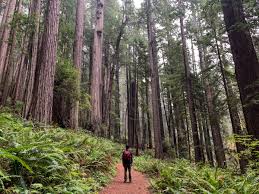
Standing in the shadows of giant redwood trees is an awe-inducing experience. In California, there’s a national park protecting those redwoods and it’s one of the state’s best-kept secrets. Home to the world’s tallest living trees, this world heritage site and international biosphere reserve protects nearly half the world’s old-growth redwoods. Come discover thousands of acres of protected forests, pristine and wild scenic rivers, and rugged coastlines hosting whales, seals, and wildflowers in California’s Redwood National Park.
Ad Break
The sweet smell of coastal forests after a rain is earthy and fresh. It’s a smell that comes and goes as it pleases, its fragrance drifting in and out of the bark and coasting along the air. Where else can you go that brings peace just from smelling the trees?
The coast redwoods here are rare and majestic trees. Other than a small patch in southern Oregon, these trees are native to California and only grow naturally here.
A tree called Hyperion stands 380 feet tall. The Golden Gate Bridge, that famous California landmark is more than 150 feet shorter than this tree. Hyperion is bigger even than the Statue of Liberty or London’s Big Ben. Some of the other trees in this forest are as wide as two small cars. But we can actually better protect this tree and others by not trekking out to see Hyperion. Instead, there are plenty of coastal giants to see on the trails and park roads that will quite simply take your breath away.
Redwoods are named for their bark and heartwood, which is reddish brown from high levels of tannin. They are naturally quite resistant to fungal disease and insect infestation and their thick bark is able to hold a lot of water, which protects them from California’s infamous wildfires.
Coast redwoods – along with giant sequoias – descended from a group of cone bearing trees more than 144 million years ago. They were here when dinosaurs roamed too. Earth was more humid then, and redwood species grew all over North America, Europe and Asia.
Changing climate and ice ages have left the planet with three small regions of redwood trees. Each of those regions is the only place in the world you’ll find native versions of that species.
Sadly, in the last century 95% of the world’s redwood trees have been logged. That makes the Redwood National Park system all the more precious as one of the last places for these very special trees.
In fact Redwood National Park is a unique partnership of state and federal parks. The system is a combined park known as Redwood National and State Parks. Along with Redwood National Park this combined system joins the state parks of Prairie Creek Redwoods, Del Norte Coast Redwoods, and Jedediah Smith Redwoods.
Together the parks preserve 140,000 acres of land – nearly half of all remaining old-growth coast redwood forests.
Yet despite its name, Redwood National and State Parks actually protect not just redwoods but also oak woodlands, meadows and wild rivers and nearly four dozen miles of rugged coastline.
Protectors of the Trees
Redwood forests once covered two million acres of the California coast. But the gold rush and timber industry brought settlers and activity that destroyed wild lands and pushed Native Americans out of their homes and their roles as stewards of wild species here.
A modern visit to the park, after years of restoration, feels pristine. But native people have lived here and tended these lands for thousands of years. The Yurok, Tolowa, and Chilula are some of the modern day Indigenous tribes with historical ties to the region.
Native peoples have relied on redwood forests but also view them as relatives and gifts from a creator. Redwoods are not just trees, but members of complex communities and ecosystems. For many people, they are sacred.
It’s easier to understand the power of these forests when standing in their physical presence. Looking up at these trees is humbling. Be careful not to hurt your neck as you stare in awe. Smell the deep aromas of the woods and the gentle peace they bring, quieting the outside world.
These trees have been on Earth so long, through storms and fires, and so many cycles of human history. Perhaps they are a reminder too of how human industry can be shortsighted, and have tremendous consequences on nature. But the trees here are also a testament to the vast universe beyond us.
These ancient giants are still under threat from logging and development. While the majority of coast redwoods are protected in parks, budget cuts are closing park areas and reducing personnel that help protect the forests.
Efforts to preserve coast redwoods and sequoia were a major part of the foundation of groups like the Sierra Club and the Save the Redwoods League. After decades of fighting for legal protection, the bill creating Redwood National Park was signed by President Johnson in 1968.
A decade later, President Carter signed an expansion of an additional 48,000 acres. This included lands that had been logged. The National Park Service was then tasked with restoring these forests. This deal was worth hundreds of millions of dollars – that’s 1970’s dollars – making it the most expensive land purchase approved by Congress.
By 1979 the Save the Redwoods League had preserved 140,000 acres. A year later, the United Nations designated the Redwood National and State Parks system a World Heritage Site.
In 2023, local tribes declared an Indigenous Marine Stewardship Area that protects the parks region, coastline and coastal waters.
Protecting the land in and around the park is crucial to supporting a healthy park, especially for migrating animals.
In 2024, the Yurok Tribe, Save the Redwoods League, the National Park Service and California State Parks signed a landmark agreement that does this.
It marks a historic step toward transferring an ecologically and culturally significant property back to the Yurok Tribe, the land’s original steward. In the Yurok language, the land is called O’Rew.
Jessica Carter, with the Save the Redwoods League says, “in 2026, Save the Redwoods League intends to return the property to the Yurok tribe. And it will become a southern gateway to Redwood National and State Parks and Yurok ancestral lands.”
For the first time, the national and state parks systems will support visitation on tribal-owned lands. This agreement is a shared vision for co-management of the land adjacent to the Redwood National and State Parks. We hope to see a new visitor and cultural center soon.
Wildlife
In addition to the rich history, cultural diversity and stunning physical beauty of this region it is important for its incredible biological diversity. It’s a great place to see seasonal wildflowers like lupine, as well as whales, seals, and elk. The park preserves ecosystems where threatened species live like Chinook salmon, northern spotted owl, and Steller’s sea lion.
About one third of the bird species found in the United States have been documented here.
Along the coast, brown pelicans and cormorants sail near cliffs and seastacks. Inland, freshwater birds are abundant, such as red-tailed hawks, herons, jays and osprey, for a total of 280 bird species in the park system.
And of course, that includes California condors.
The Yurok call California condors prey-go-neesh. In 2022, the first condors were brought into their release pen as part of the Northern California Condor Restoration Program. Since then, condors have been returning to the Redwoods.
It’s a huge success for the effort to restore California condors to traditional Yurok territories across Redwood National and State Parks.
It’s also the result of decades of teamwork between the Yurok Tribe, the Park Service, and other conservation agencies and organizations.
The individual birds have garnered quite a bit of fame, thanks to some great educational storytelling by the restoration programs that include watching condors on webcams. You can learn more about this program and watch the webcams online.
Some important ways to help the condor restoration program include making donations online and making sure to clean up your trash on your visit. Even micro trash such as bottlecaps pose a threat to these vulnerable scavengers.
You can also help support the movement to ban lead ammunition, which poisons condors. But making a visit to the Redwood National and State Parks is also a great way to support the programs too.
On your visit you’ll see other wildlife as well, like elk. Roosevelt elk are tall and majestic, like the forests around them, though… maybe not quite as tall.
They are the largest of the six subspecies of elk in North America and are only found in scattered areas of the far north of California.
Seven herds roam through the parks. They live in forests, prairies, creek bars and beaches.
The best places to spot the elk are in Prairie Creek Redwoods State Park, Elk Meadow, Gold Bluffs Beach by Fern Canyon, and Lower Redwood Creek. Roosevelt elk may also be seen from the Freshwater Lagoon south of the Klamath River to Crescent Beach north of the river.
During the fall, the animals are in rut, and may become more aggressive to humans. If an elk charges your group, take cover behind or in a tree, and let a ranger know.
You’ll have plenty of opportunities to take great photos of the elk herds. But please keep your distance. The females have a strong kick, especially protecting their young, that can be lethal.
You don’t want to be on the wrong side of the antlers of a male defending their territory either.
Simply stay far back from the herd and enjoy nature-watching from a distance.
Visiting the Park
Entry to the Redwood National Park system is free. But this is a park system that is best enjoyed with some careful planning. Before you go, here are some tips for visiting the park.
First, northern California is a great place to explore with your RV. However, some of the scenic roads through the forests are narrow. And some campgrounds were designed before modern RVs. Places to avoid in your RV include Fern Canyon, Lady Bird Johnson Grove, the Bald Hills and Tall Trees Grove.
But don’t worry, there are still plenty of places to adventure with your recreational vehicle at Redwood National Park. There is great RV parking at the Yurok Loop Trail, along the Newton B. Drury Scenic Parkway, the Big Tree Wayside and of course at the Trillium Falls Trail.
The wild beauty of the northwestern corner of California also means it is remote. By planning ahead you can comfortably enjoy your stay. Check local chambers of commerce for lodging and meals. There are no restaurants or lodges in the park.
Inside the park, developed campsites require reservations in the summer, and a permit is required for backcountry camping, which you’ll have to hike to get to. There are plenty of places to camp outside park boundaries and you can reserve cabins in advance at nearby Smith River National Recreation Area.
Remember that pets are welcome in developed areas but not on park trails. However, there are places to take leashed dogs under the redwood canopy on Cal Barrel Road.
And if you stop by one of the many visitor centers, your pup can earn a Bark Ranger badge and certificate. Yes, that’s bark with a b!
If you come to California’s Redwood National Park, get your hiking boots on, and enjoy almost 200 miles of hiking trails in the larger national and state park system.
If you’re just passing through, you’ll find an easy, flat, 2 and a half mile walk in the Prairie Creek Trail, although the signs might reflect its new name: the Karl Knapp Trail. You can meander along a creek under some of the tallest redwood trees in the world, including a few hundred feet of the Cathedral Trees Trail.
This is a great way to get introduced to the park and figure out where you want to go. Many other trails lead off from this loop, and free maps are available at the Prairie Creek Visitor Center.
If you have a family in tow, you might want to try the very short hike to Trillium Falls. This trail takes you through old-growth forests of redwood, maple and fir trees. You’ll see trillium flowers and ferns and end with a 200-foot elevation gain to see the waterfalls. To extend the hike, the full loop is three miles long.
For this family-friendly hike, start at the trailhead at Elk Meadow. Here you’ll find one of the areas good for buses, trailers and RVs, along with flush toilets and a picnic area. But best of all, you’ll probably see Roosevelt elk in the meadow.
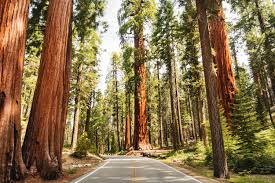
For those who prefer to see the sights on wheels, head over to the ten miles of the Newton B. Drury Scenic Parkway. This might be the most stunning drive – or ride – of your life. Go slowly!
This road is found in the heart of Prairie Creek State Park. You’ll pass thousands of acres of old-growth redwood forests. There are plenty of well-marked trails and pullouts for vehicles of all sizes. The Prairie Creek Visitor Center is at the southern end.
From October to May, the Park Service closes the Newton B. Drury Scenic Parkway to motor vehicles on the first Saturday of each month. California’s temperate weather means people can enjoy a crisp but comfortable experience.
On that Bike and Hike day there are visitors hiking, walking leashed-dogs, pushing strollers, or wheeling mobility chairs along this incredible once-in-a-lifetime parkway.
Newton B. Drury was a man who spent his life fighting to protect these forests. Newton Drury was the fourth director of the National Park Service. At one time he was also director of the California State Parks and the Save the Redwoods League. He was a key figure in ensuring hundreds of thousands of acres were protected for the public.
Beyond these hikes, if you’ve come to stay for a while, there are some all-day hikes you might enjoy, like hiking the James Irvine Trail to Fern Canyon Loop.
Start at the Prairie Creek Visitor Center. This 12-mile loop takes those with an adventurous spirit from the redwoods through spruce forests to the ocean and back. Give yourself a good half day or even all day to enjoy the views.
Fern Canyon is a stunning mini-canyon covered entirely with ferns, like the name suggests. But that doesn’t do this little canyon justice and you’ll be sure to take photos along the way.
Located east of Gold Bluffs Beach, be prepared to get your feet wet on this part of the loop. Seasonal footbridges in the summer help hikers in this area – as do waterproof shoes.
You’ll walk through the creek canyon, be cooled by ocean breeze, and climb over fallen trees. It’s definitely best to be agile and able bodied for this hike. But it will be a walk to remember. Nature writers around the world have remarked on the beauty of this experience.
Before you trek out to Fern Canyon, check the road conditions on the park website. You can also see if footbridges are up. Restrooms and a picnic area round out the experience in the Fern Canyon parking area. But that’s not all. You can also leave the canyon and walk to the beach to view the mighty Pacific.
For more information, visit the National Park Service website for Redwood National Park and learn more about the unique combined national and state park system here in northern California and these native coastal redwood forests.
Discover more from Jennifer Molidor
Subscribe to get the latest posts sent to your email.

Leave a comment